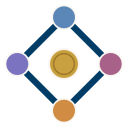
hub-spoke
Hub and spoke — one center, its satellites, and what flows between them.
Use bar or stacked-bar instead when the claim is a ranking or a share: a length or a stacked segment compares values far better than a disc does. Use hub-spoke when the claim is the STRUCTURE — one center and what hangs off it (a program office and its workstreams, a platform and its partners, a distribution center and its regions) — with the values printed beside each satellite. Satellites are neutral unless you group them; a status pill (at-risk, blocked) marks its own spoke; sized scales disc area and flow-out / flow-in / flow-both step connector weight, only when you ask.
When to use
- The structure is the claim. A program office and its workstreams, a platform and its partners, a hub warehouse and the regions it serves. Six to eight satellites read best; twelve is the cap.
- Status on a structure. Mark the off-track spokes with a status pill (
at-risk,blocked). Only those spokes change: a halo, a heavier edge, the state color and the spoken word. Nothing else recedes, so the rest of the structure still reads. - Concentration, with the number printed. Add
sizedto scale disc AREA by value and print each share beside its disc (28%). Area comparison is weak, so the printed number carries the claim; past eight satellites usebar. - What flows to and from a center. Add
flow-out,flow-inorflow-bothto draw arrowheads and step the connector weight by value in four classes. Mark an exception on one spoke with aflow:inpill. - Two levels, kept small. Add
tieredto hang leaves off each satellite: up to 6 branches and 18 leaves. Each branch takes its own hue, so the branch is the group.
When not to use
- A ranking or a share. If the point is who is biggest, or how a total splits, use
barorstacked-bar. A length compares far better than a disc, andsizedis a supporting cue here, not the evidence. - A network, not a star. Hub-spoke draws one center and its spokes. If the satellites connect to each other, or there are several centers, use
diagram(Mermaid) for the graph. - A hue per satellite. Satellites are neutral on purpose: each one has its name beside it, so a color per satellite adds nothing and past six it invents false groups. Group them with a pill only when the grouping is part of the claim.
- A process in order. Steps that happen one after another are a sequence, not a hub. Use
list-steps,funnelortimeline-list.
Common mistakes
- Two top-level items, or the satellites written at the top level. Write ONE top-level item (the hub) and nest every satellite under it.
- A group name that starts with a digit (
3PL,5G). The family reads a pill that starts with a digit as a value. Spell the group out (Third-party logistics,Cellular). - A group named with a status word (
Live,Pilot,Done). Status words mark a spoke's state and paint a state color. Name groups with other words. - Two value pills on one satellite (
$18M28%). A spoke prints ONE value. Put the second figure in the satellite's detail sublist. sizedwith a missing, zero or negative value, or values in two units. Sizing needs every satellite to carry a positive value in one unit; otherwise it switches off and the linter says why.
Authoring
<!-- _class: hub-spoke -->

`Eyebrow · context`

## What the structure shows.

- Hub
  - First satellite
  - Second satellite `at-risk`
  - Third satellite
  - Fourth satellite
Slots
| Slot | Selector | Required | Description |
|---|---|---|---|
title | h2 | yes | Slide heading naming the takeaway the structure shows. |
hub | ul > li | yes | Exactly ONE top-level item: the hub. Its name prints inside the hub disc; an optional value pill ($48M, 12,000) prints under it. A second top-level item is not drawn (lint hub-spoke-extra-hub), and a status pill on the hub is ignored (lint hub-spoke-hub-status). An icon record ({icon=warehouse}) draws the icon inside the hub disc above its name; {icon=warehouse, icon-only} draws it in place of the name, which stays the disc's title and its accessible name. |
satellites | li > ul > li | yes | The hub's nested items, one per satellite, drawn clockwise from about one o'clock (at most 12; tiered: at most 6 branches). Pills after the name, in any order: at most ONE value ($18M, 62%, 3,600 — the family value test), a status word (at-risk, blocked, on-track, live…) that marks that spoke only, flow:in / flow:out / flow:both for that spoke's arrowhead, and any other word as the satellite's GROUP (up to 6 groups get a hue and a key). One icon record per item, {icon=database}, draws that icon inside the satellite's disc (a branch's or a leaf's under tiered), and {icon=database, icon-only} drops the label beside the disc: the name stays its hover title and what the chart's description reads. The record takes icon= and icon-only only; the value, status and group stay their own pills. |
detail | li > ul > li > ul | no | Optional nested sublist under a satellite (under a LEAF with tiered, one level deeper). Drives the shared chart-family detail substrate: the Present/Practice popover on the satellite's disc, and a speaker-note line in the static PDF, with the chart pixels unchanged. Detail sublists must be bullet (-/*) lists. |
Data shape
- Author satellites in the order you want them read: the first sits at about one o'clock and the rest run clockwise.
- Keep satellite names short — up to 40 characters at seven spokes, 22 at twelve (20 or fewer on a portrait deck). A name wraps and never truncates. The linter also totals the rows the labels print (name lines, values, statuses): past 22 rows, or 24 at twelve spokes,
hub-spoke-crowdedwarns that labels may fall back to a column with leaders. - With
tiered, keep leaf names to 14 characters and branch names to 16, and stay at 14 leaves or fewer for a layout the linter treats as proven; the kernel still draws up to 18. When a branch name has no clear lane beside its disc, the branch names move into a key band under the figure. - Keep the hub name under about 40 characters and its value under 12. The hub never outgrows three times the largest satellite; long text shrinks instead, and past the smallest type the linter flags it.
- Satellite values under
sizedshould share one unit and be positive; the hub value is not drawn to scale, and the linter warns only when the satellites add up to MORE than the hub. - Under a
marks:(pigment,etchortone), the finish repaints the group discs, the key and a status disc's level; the hub and neutral satellites carry no color, so they stay as drawn. Undertonea group's connectors, arrowheads and names join the one hue with its discs. On a slide with groups,pigmentandtonedraw the hub in the full heading ink, so no group disc reaches the hub's lightness.
Anatomy
┌─────────────────────────────────────────┐
│  header                                 │
│            Structure heading            │
│                                         │
│       Name  (o)        (o)  Name        │
│                 \  ___  /               │
│       Name (o)--( HUB )--(o) Name       │
│                 /  ---  \               │
│       Name  (o)        (o)  Name        │
│  footer                           1/19  │
└─────────────────────────────────────────┘
Variant decision rule
- default (no modifier) — The structure is the claim and the values, if any, are subtext: every satellite prints its name, value and status, and nothing scales.
sized— Each value belongs to its satellite (revenue per partner, headcount per team) and concentration is part of the story. Every satellite needs a positive value in one unit, at most 8 of them. Print shares when the comparison matters.flow-out— The value moves FROM the hub along each spoke (shipments out, budget allocated). Heads point at the satellites and connector weight steps by value in four classes.flow-in— The value moves TO the hub (feeds in, revenue collected). Heads point at the hub.flow-both— The value is traded both ways along every spoke (tickets raised and resolved).tiered— Each satellite has its own small set of children that belong on the slide: up to 6 branches and 18 leaves. Values print but do not scale.
Variants
sized — sized
Disc area carries each value.
<!-- _class: hub-spoke sized -->

`FY2026 · Partner channel revenue · share of $120M`

## Two partners carry half of channel revenue.

- Channel revenue `$120M`
  - Atlas Distribution `28%`
  - Keystone Resellers `22%`
  - Northgate Systems `18%`
  - Brightline Retail `13%`
  - Summit Online `11%`
- Harborview Telecom `8%`flow-out — flow-out
Arrowheads and stepped connector weight.
<!-- _class: hub-spoke flow-out -->

`Memphis distribution center · Pallets per week`

## The Northeast and Southeast take over half of outbound volume.

- Memphis DC `12,000`
  - Northeast `3,600`
  - Southeast `3,100`
  - Midwest `2,400`
  - Southwest `1,700`
  - West `1,200`
- Returns center `400` `flow:in`flow-in — flow-in
Heads point at the hub.
<!-- _class: hub-spoke flow-in -->

`Data platform · Records ingested per day`

## Billing and the web store send two thirds of what the lake takes in.

- Data lake `45M`
  - Billing `16M`
  - Web store `14M`
  - Mobile app `8M`
  - Call center `4M`
- Partner feeds `3M`flow-both — flow-both
Two-way flow on every spoke.
<!-- _class: hub-spoke flow-both -->

`Shared services · Tickets per month`

## Finance and HR trade the most work with the service desk.

- Service desk `9,400`
  - Finance `2,900`
  - HR `2,600`
  - Facilities `1,500`
  - Legal `1,300`
- Procurement `1,100`tiered — tiered
Branches, with leaves off each one.
<!-- _class: hub-spoke tiered -->

`Platform organization · Service ownership · 2026`

## Four platform teams own eleven services; two are in trouble.

- Platform org
  - Payments
    - Card issuing
    - Acquiring
    - Fraud scoring `at-risk`
  - Data
    - Warehouse
    - Streaming
    - ML platform
  - Identity
    - Login
    - Consent
  - Core banking
    - Ledger `blocked`
    - Accounts
- StatementsRelated
- barthe claim is a ranking — lengths compare better than areas
- stacked-barthe claim is how one total splits into shares
- piechartthree to six shares of one whole, and the proportion is the story
- diagramthe satellites connect to each other, or there is more than one center
- state-chartthe arrows are transitions between states, not flows to a center